
TRANSEATION and Green Living Projects (GLP): Towards Regenerative Evaluation of coastal and marine infrastructure
Green Living Projects for TRANSEATION · Notes from the sourcing phase · No. 1 — July 2026.
By Editorial Staff
What did we set out to do?
After nearly twenty years of regenerative work on land, Green Living Projects is expanding its practice into the sea. As a member of the TRANSEATION consortium, Green Living Projects has taken on the challenge to work on coastal and marine infrastructure, ports and coastal defences, offshore wind, aquaculture, artificial reefs and the other structures that increasingly shape life along the coast and beneath the waves.
For Green Living Projects, this is not a change of direction but rather a widening of our inquiry: how do we move from reducing harm to creating the conditions for life to thrive?
Within TRANSEATION, our task (Work Package 15) is to develop a way to evaluate, and in time to rate, how regenerative coastal or marine infrastructure can be. Before starting with the design of such a system, we went through a foundational research phase understanding what we were dealing with and what already exists. This article shares where that inquiry began and how it has been unfolding.
Our first inquiry focused on understanding what kind of infrastructure we are talking about. Our experience so far had largely been with the built environment, and buildings are relatively familiar objects for us. They have walls, roofs, users, defined sites and identifiable functions. People live, work and gather within them. Coastal and marine infrastructure is far more diverse, it entails ports and marinas, breakwaters and seawalls, offshore energy installations, aquaculture systems, desalination plants, coastal protection works, recreational structures and more. The language around it is slippery as well: blue-grey infrastructure, hybrid blue-grey infrastructure, nature-based solutions.
So the first thing we set out to do was to have clarity about what it is we are considering.
As a defining criterium, we did not look at where infrastructure is sited and what it does: infrastructure placed within open, highly dynamic marine and coastal systems, shaped by currents, tides, sediment, migration, weather, ecological relationships and human activity.
That quickly led to a difference that sounds obvious but that changes things quite a lot. A building is designed primarily for human occupation, which is why building rating systems pay such close attention to indoor air quality, thermal comfort, daylight, acoustics, accessibility and the health of occupants. Most marine infrastructure is not inhabited by people at all. A breakwater, an offshore wind foundation, a seawall, for these, indoor air quality and daylight are simply irrelevant.
And yet marine infrastructure is never placed in empty space. A breakwater enters waters already inhabited by fish, algae, molluscs, microorganisms and countless other forms of life. It changes currents, sediment movement, habitat, temperature and light. So perhaps the more accurate way to put it is this: marine infrastructure may not be inhabited by people, but it enters an already inhabited living system.
That single shift provides an important framing for the work ahead. Of course, it remains important to ask whether a structure performs its function well, uses less energy and materials, and structurally stands up to storms and a changing climate.
But we must also ask how it alters the conditions for life: which species and ecological processes it affects, what relationships it interrupts or creates, and how it becomes a meaningful participant in the living systems around it. Before choosing any indicator, in other words, we had to reconsider who, or what, the infrastructure is being designed for.
Can we borrow the tools we already have?
The obvious next step was to look at the rating systems that already exist and ask whether one of them could simply be adapted:
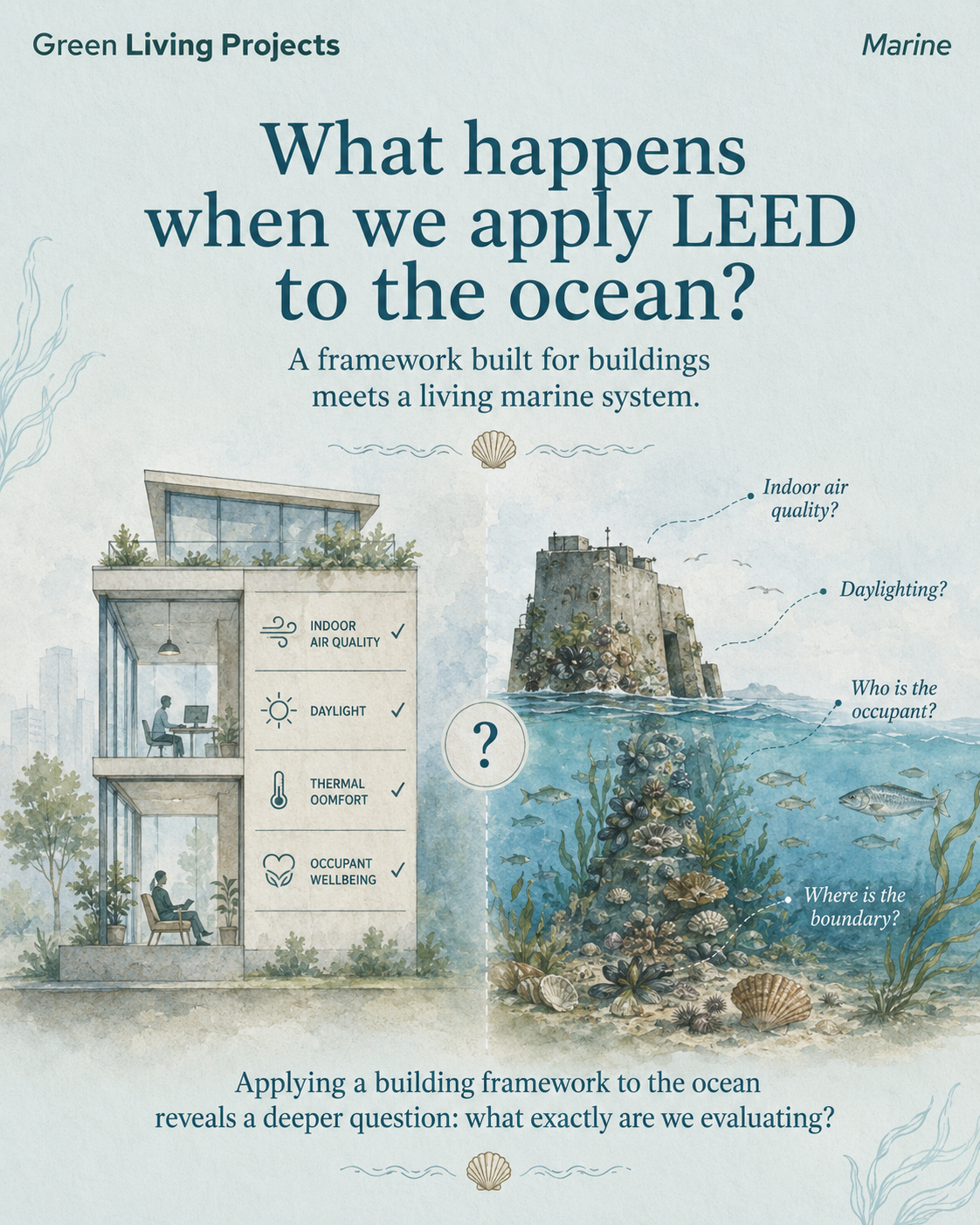
- LEED was the natural first candidate. It has genuinely helped transform the building industry, providing a shared language for energy, water, materials, transport and indoor environmental quality that made performance visible, measurable and comparable. But imagine assessing a breakwater, an artificial reef or an offshore wind foundation through it. What would indoor air quality mean? What would daylighting mean? Who is the occupant, and where is the project boundary? How would it account for sediment movement, migration routes and effects that unfold far beyond the site itself? LEED is built specifically for buildings, above all buildings occupied by people, and its categories reflect that purpose. There is little point in trying to build a “marine version” of it.
- SITES is a system that comes closer to what we are looking for. The Sustainable SITES Initiative was built not for buildings but for landscapes, and its categories are ecological where LEED’s are technical: soil, hydrology, vegetation, habitat and the ecosystem services a site provides. It treats the landscape as a living entity, embeds systems thinking in design, and even arranges its ambition as a hierarchy from preservation through conservation to regeneration. Of the familiar rating systems, it speaks the language closest to what we are looking for. But two things kept it from becoming our foundation. First, SITES remains a point-based credit system carrying the same performance-optimisation logic as other rating systems. Restoration is scored as a technical outcome achieved once, rather than an evolving, developmental process a place moves through over time. And second, it is built for terrestrial sites such as gardens, parks, campuses, not for the open, dynamic marine and coastal systems, shaped by tides, currents and sediment. SITES would be a better starting point but it didn´t provide us with the co-evolutionary, place-sourced structure a regenerative evaluation needs.
- Envision looked promising. It was created for civil infrastructure, transport, water, energy, public space, and organises itself around five broad areas including Quality of Life, Leadership, the Natural World, and Climate and Resilience. It recognises that infrastructure affects communities, considers habitat and ecosystem services, and takes leadership, collaboration and stakeholder involvement seriously. It understands that infrastructure is shaped not only by engineering but by governance, institutions, finance and the quality of collaboration between those involved. That is a meaningful step up from LEED: a broader field of attention that reaches beyond purely technical performance.
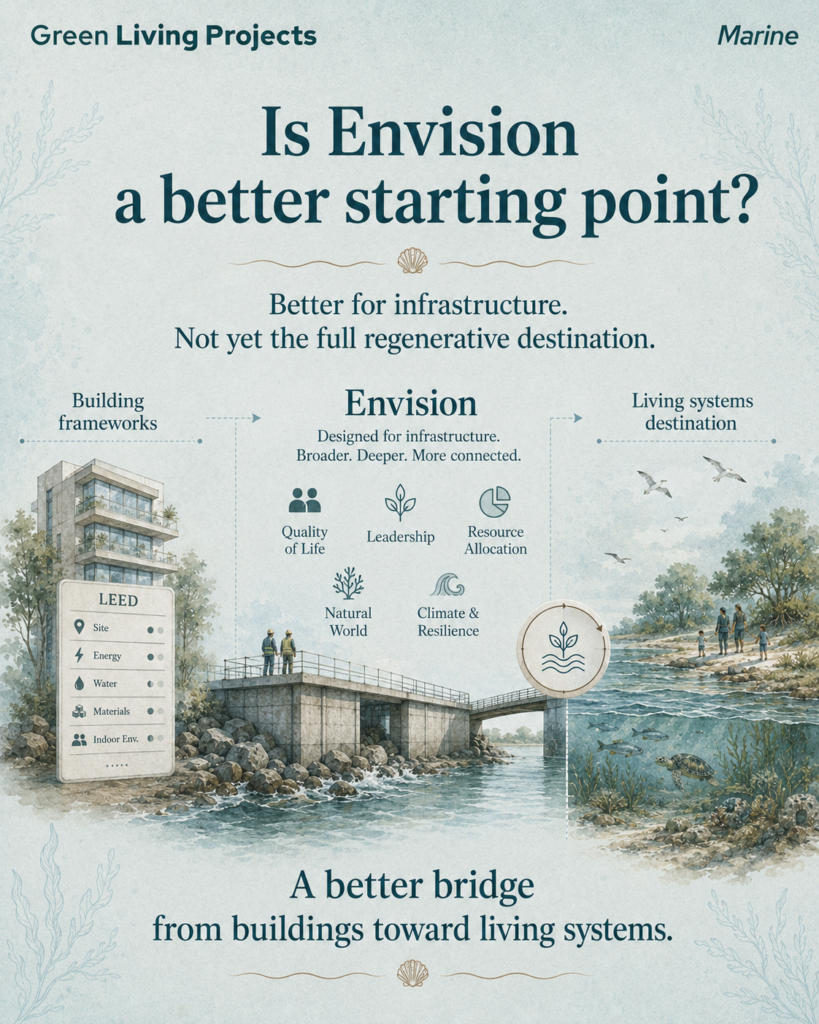
But is it enough? Like most rating systems, Envision works through predefined categories, weighted credits, documented evidence and third-party verification. It can confirm that a collaborative team was established, but can it demonstrate whether a project team developed a deeper understanding of living systems in place? It can record that stakeholders were involved but can it distinguish consultation from genuine co-creation? It can note that decision-making processes existed, but how do we evaluate whether these processes made people and institutions more able to learn, adapt and evolve? Because of the credit-and-point structure, these deeper questions seem to slip through. After all, it remains, at heart, a checklist. And as we evaluated different rating systems, we concluded a checklist approach is not going to do the job.
Every rating system contains a worldview
Working through existing rating systems led us to a realisation that has become central to our research. Rating systems tend to look alike, categories, indicators, thresholds and points, all aimed at measuring performance. But beneath these points, there is an invisible set of assumptions: about what a project is, where its boundaries lie, what matters, and what success looks like. In other words, every rating system contains a worldview.
A building rating system assumes the project is the defined object on a limited site, designed mainly for human use. That is exactly why it attends to energy, comfort and occupant wellbeing. Move into the sea and those assumptions can be questioned. A breakwater is not only a structure; it changes wave energy, sediment, water circulation and habitat. An offshore wind foundation is not only an energy asset; it becomes part of a marine territory shaped by species, fisheries, currents, communities, regulation and long-term ecological change.
So, a central reflection became “What understanding of the world is built into the way we evaluate it?” Do we develop another framework that treats nature mainly as context, as a set of resources, or as ecosystem services? Or do we develop a framework that recognizes living systems with their own dynamics, relationships and capacity to evolve? Do we evaluate projects as isolated objects, or as participants in relationship with living systems in a wider place? These are not just philosophical differences. They determine what a rating system has to make visible and what is being encouraged.
The challenge, we came to see, is not simply to design better indicators for marine infrastructure. It is to start by questioning the worldview built into the system itself and develop something innovative founded on that worldview!
As we pointed out earlier, existing rating systems focus on the project. They draw its boundary, break its performance into categories, assign indicators and set thresholds to be met for points. It is, in a sense, a gamification of sustainability: play well and you win a prize, Silver, Gold, even Platinum. That makes sense if the project is the thing being evaluated.
But what if the evaluand is not the project but the project in relationship with place?
A port, a breakwater, an offshore wind farm or a coastal defence is embedded in a place with its own ecological identity, cultural history, economic patterns, relationships and future potential. So, the project alone cannot be the thing to be evaluated. What needs evaluating is the project in relationship with its place, and that leads to different questions. What is the unique character and potential of a place? How does the project affect the relationships that sustain it? Does it strengthen or weaken ecological, social and economic patterns? What new capacities does it help create for the place to become more vital, more viable, and more able to evolve?
This is a different definition of success. A coastal defence may be robust but still starve a beach of sediment, degrade habitat, or cut a community off from its own shoreline. An offshore energy project may deliver renewable power at a competitive price while weakening local fisheries, eroding local trust, or harming the wider marine system. The core question for a regenerative development therefore becomes: “How, and to what extent, does this project contribute to the continuing health and evolution of its place?”
Of course, that does not mean we have to throw technical performance and environmental impact overboard. We shouldn’t and there are plenty of good tools out there to evaluate that.
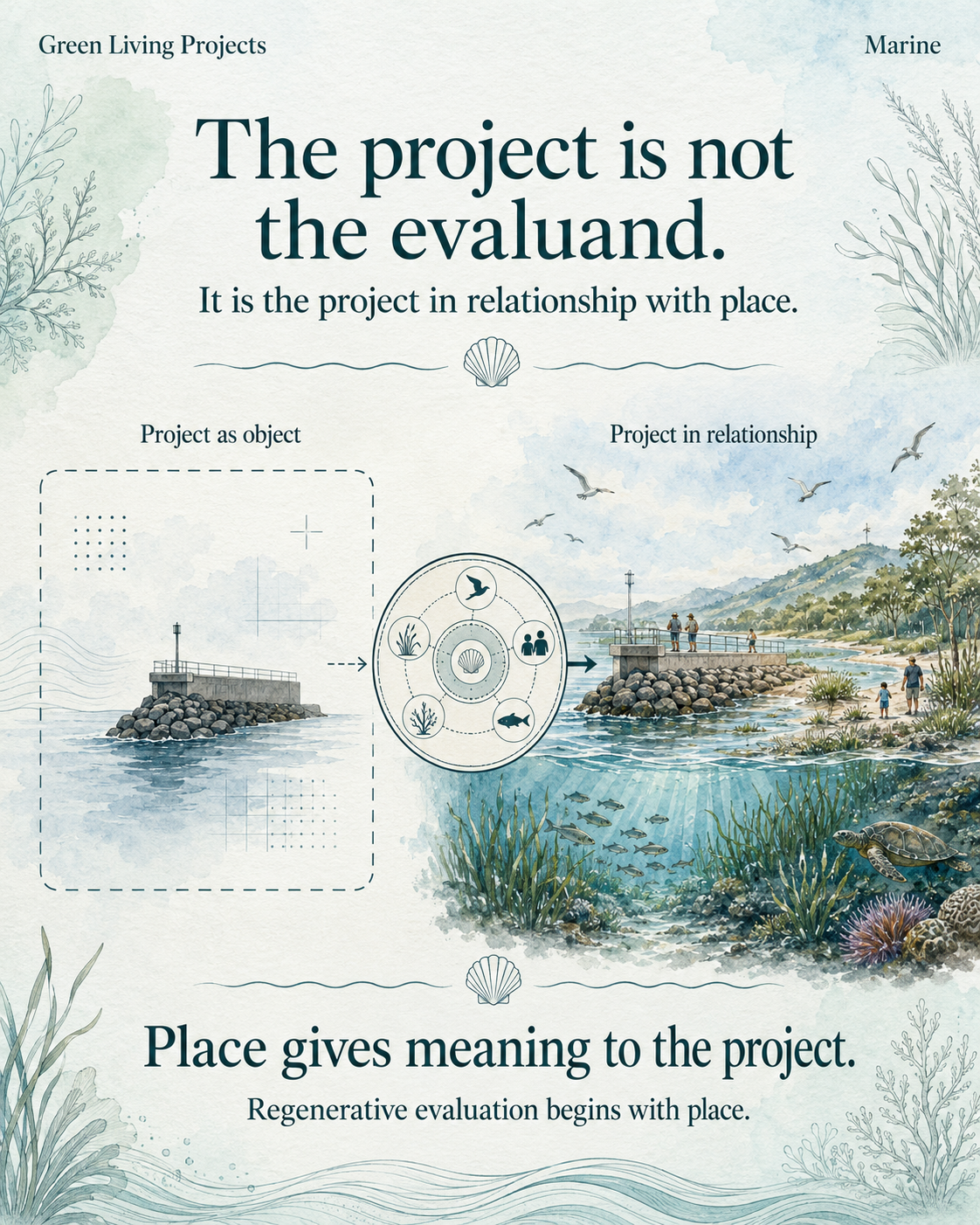
Instead of focusing on what other rating systems already focus on, we need to focus on how we can understand infrastructure as an intervention in a living whole. How infrastructure relates to life in a place: does it diminish life, coexist with it or does it actively contribute to its capacity to thrive all the while performing the original function the infrastructure is designed for.
This is a foundational insight in the development of a regenerative rating system and it is the main reason it differs from existing rating systems: a regenerative approach asks us to let place become the context that gives a project meaning and to judge the project by the quality of its contribution to life in that place.
Places cannot be understood in a single, uncontested way. A fisher, an ecologist, a port authority and someone who grew up on that shoreline may all be describing the same bay while experiencing it very differently. It considers ecological needs, livelihoods, cultural meaning and future hopes that do not always align. That means that understanding place has to do with participation, governance and collective learning.
Our sourcing research led us, step by step, away from the idea of a “marine version” of an existing rating system and toward something genuinely different. Not a checklist that scores a finished project against a fixed list, but an evaluation works with a project, the community and the place around it, learning and developing over time. An evaluation grounded not in the performance of a technical asset but in the relationship between project, place and community.
That has laid a foundation for the further development of the rating system. In the months ahead we will be sharing how we turned these foundations forward towards a regenerative rating system for marine and coastal infrastructure.
This work is carried out by Green Living Projects within TRANSEATION, a project funded by the European Union’s Horizon Europe research and innovation programme. Views and opinions expressed are those of the authors only and do not necessarily reflect those of the European Union or the granting authority, which cannot be held responsible for them.